The 3-month size is among the most purchased in baby gear, yet its actual wearing duration remains unclear for many parents. Between the size differences from one infant to another and the variations in cuts between brands, the question deserves a concrete examination, far from the standardized charts that circulate everywhere.
Differences Between Brands: Why the 3-Month Size Doesn’t Mean the Same Thing Everywhere
A point rarely made upfront: the 3-month size varies from 56 to 62 cm depending on the brands. Vertbaudet, Kiabi, or other brands do not apply the same height standards. A body labeled 3 months from one brand may correspond to a 1 month from another, or conversely, be close to a 6 months size.
This lack of a single standard has direct consequences: a parent preparing the layette in advance risks ending up with unusable clothing if the chosen brand runs small or large compared to the baby’s actual morphology. To know how long a baby wears 3 months, it is therefore necessary to think in centimeters rather than age.
In practice, an infant measuring about 54 cm at birth may fit into 3 months as early as their first weeks with certain brands. Another, born smaller, may not fit into it until several weeks later. The age label is a commercial reference, not a physiological measurement.
Actual Wearing Duration of 3 Months: What Infant Growth Allows Us to Estimate
An infant’s growth between birth and six months is rapid, but it does not follow a linear pace. It alternates between growth spurts (where the infant can gain several centimeters in a few days) and plateau phases.
For an average-sized baby born around 50 cm, the transition to 3 months often occurs between the third and fourth week of life. Exiting this size generally happens between two and a half months and three and a half months. The usage window is therefore around six to ten weeks for most infants.
Field reports vary on this point: some larger babies wear 3 months for less than four weeks before moving to 6 months. Others, born prematurely or smaller, may stay in this size for a full three months. Weight and morphology (long or short torso, chubby or thin thighs) play as much of a role as height.
The Trap of Excess Stock
With such a variable usage duration, buying ten 3-month pajamas poses a real risk of waste. It is better to start with a limited lot and supplement over the weeks based on the observed growth rate.
Shrinking in Wash: A Factor That Shortens Wearing Duration
An often underestimated aspect: frequent washing significantly reduces the usage period of a size. Tests conducted by UFC-Que Choisir show that some cotton bodies and pajamas shrink noticeably after about ten washes at 40 °C. The length of the torso and inseam decreases, making the garment too short even before the baby has actually outgrown the size.
For an infant who frequently regurgitates or during the weaning period, outfit changes are daily, sometimes multiple. The washing cycle accelerates, and clothes wear out faster than expected.
Limiting Shrinkage
- Prefer washing at 30 °C when the laundry is not heavily soiled, to preserve the cotton fibers
- Air dry rather than using a tumble dryer, the main culprit of mechanical shrinkage
- Check the composition on the label: cotton-elastane blends resist deformation better than pure cotton
Adjustable and Evolving Clothing: A Concrete Alternative Around 3 Months
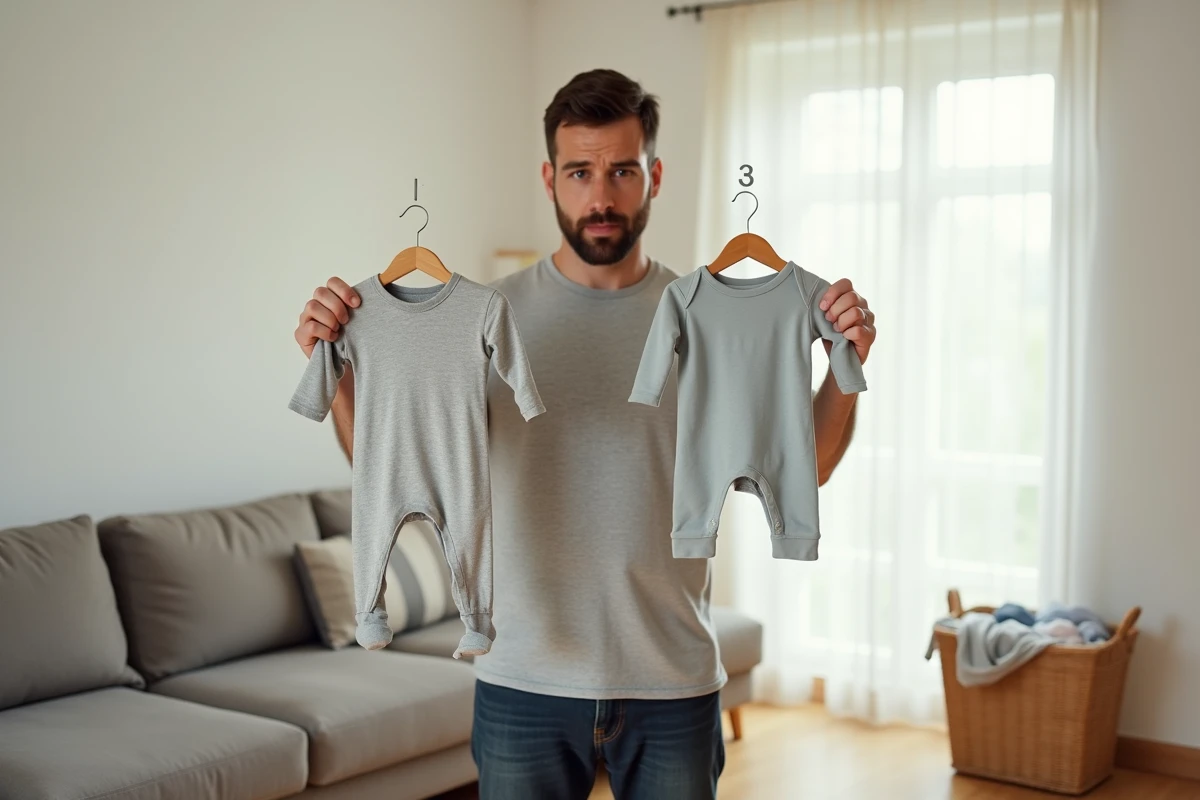
Several brands now offer clothing designed to cover two to three age ranges. Leggings with foldable hems, bodies with adjustable snaps at the crotch, expandable overalls: these pieces indicate usage ranges like 0-6 months or 3-9 months.
A well-designed evolving garment can double the wearing duration compared to a fixed size. The principle relies on adjustment systems (snaps, elastics, sewn pleats) that allow the garment to adapt as the baby grows.
Limits do exist: comfort may decrease at the beginning or end of the usage range, and not all models live up to their promises after several washes. However, for everyday pieces (bodies, pajamas), investing in evolving clothing reduces the number of necessary garments and limits emergency purchases between sizes.
Choosing the Right 3-Month Size Clothing: Concrete Criteria
Rather than multiplying pieces, focusing the budget on truly functional clothing makes a significant difference in daily life.
- Pajamas with front zippers make nighttime changes easier compared to snap buttons, especially when the parent is tired
- Crossed bodies (also called wrap bodies) avoid putting the garment over the head, a move that many newborns dislike
- Wide cuff socks stay on the feet better than tight elastic models, which leave marks on the skin
- For bodies, prefer an American neckline (shoulders that open) rather than a classic round neckline: in case of a diaper overflow, the body can be removed from the bottom without soiling the face
The season question also matters. A baby born in winter will need long-sleeved bodies in 3 months, while a spring baby will likely wear short sleeves. Adapting purchases to the actual wearing season, not the birth season, avoids the most common mistakes.
The 3-month layette benefits from remaining modular: a few basic pieces purchased before birth, supplemented after two or three weeks when the baby’s growth curve begins to take shape. This gradual approach remains the most reliable way to avoid sizes that are never worn.